Where to Buy Certified Gemstones Online in India A Complete Buyer’s Guide
Rahul Goyal leads Rahul Goyal Official, a Jaipur-based astrology and gemstone co...
By admin
If you are trying to find the best gemstone according to horoscopes, a Rashi chart is an obvious place to begin. It tells you which stones have traditionally been connected with different Rashis. What it does not tell you is whether that stone is the right choice for every person born under the same Rashi.
That distinction matters.
In traditional Vedic astrology, a gemstone may be considered after looking at the Janma Rashi, Lagna, planetary positions and the complete Kundli. So the Rashi gives you a starting point; the birth chart adds the personal details.
This guide explains how that process is traditionally approached, along with the Rashi wise gemstone associations you will commonly come across.
There is no one stone that fits every horoscope.
Ruby is traditionally linked with the Sun, Pearl with the Moon, Emerald with Mercury and Yellow Sapphire with Jupiter. Similar associations exist for the other planets as well.
But knowing the planet connected with a gemstone is only part of the picture.
Suppose two people have the same Janma Rashi. That does not mean everything else in their charts will match. Their Lagna may be different. Planets may fall in different houses, and their relationships with one another may also change.
This is why a Rashi chart works well as a reference, while a more personal recommendation may involve reading the complete Kundli.
There is not a single step that settles the question. In traditional astrology, several parts of the birth chart may be looked at before a gemstone is considered.
Janma Rashi is the Rashi occupied by the Moon at the time of birth. You may also hear it referred to as the Moon sign.
For many people, this is where the search begins.
Once you know your Janma Rashi, you can see which planet rules it and which gemstone is traditionally connected with that planet.
That's useful information, but it should not be mistaken for a complete reading of your horoscope.
The Lagna, or Ascendant, depends on the sign rising at the eastern horizon when you were born.
Why does that matter here?
Because the Lagna is used in traditional Vedic astrology when looking at the houses in a birth chart and the planets that rule them. A change in Lagna can change the way the rest of the chart is read.
So two people can have the same Moon sign and still have noticeably different Kundlis.
That's one reason a gemstone chosen from Rashi alone may not always be the same stone considered after a fuller horoscope reading.
A Kundli gives much more information than the name of your Rashi.
When it is being read for gemstone selection, the astrologer may consider things such as:
The point is not simply to find a "weak planet" and buy its gemstone. The planet has to be understood in relation to the rest of the horoscope under the astrological system being followed.
The basic associations are fairly easy to remember:
These are traditional associations, not an instruction that everyone should wear all the stones linked with planets in their chart.
For example, knowing that Blue Sapphire is associated with Saturn tells you what the stone traditionally represents. It does not, by itself, answer whether you personally should wear Blue Sapphire.
That is a different question.
This is where Rashi only recommendations have their limits.
Take two people who share the same Moon sign. One may have been born early in the morning, while the other was born late at night. Their places of birth may be hundreds of kilometres apart.
Their Rashi can still be the same, but other parts of their charts may not be.
Their Ascendants can differ. Planets can occupy different houses. Dashas, aspects and conjunctions can also vary.
So if you are buying an expensive gemstone because of an astrological recommendation, it is worth knowing whether that recommendation came from your complete horoscope or simply from a Rashi list found online.
Choosing a type of gemstone is one decision. Choosing the actual stone is another.
If you are spending a significant amount, do not judge a Ruby, Emerald or Blue Sapphire only from a polished photograph.
Look at the details:
A few of these terms are often confused.
A natural stone can still have undergone treatment. A synthetic gemstone is produced in a laboratory. An imitation is another material made to resemble a particular gemstone.
Knowing the difference helps you understand what you're paying for.
If you don't already know your Janma Rashi, three birth details are normally required:
These details are used to work out the Moon's position when you were born. The Rashi in which the Moon was placed is your Janma Rashi in Vedic astrology.
This also explains a common source of confusion. The zodiac sign someone knows from a Western horoscope is not necessarily the same as their Janma Rashi.
Once the Moon sign is known, a Rashi gemstone chart can be used for general reference.
The following table gives the commonly cited traditional Rashi, ruling planet and gemstone associations.
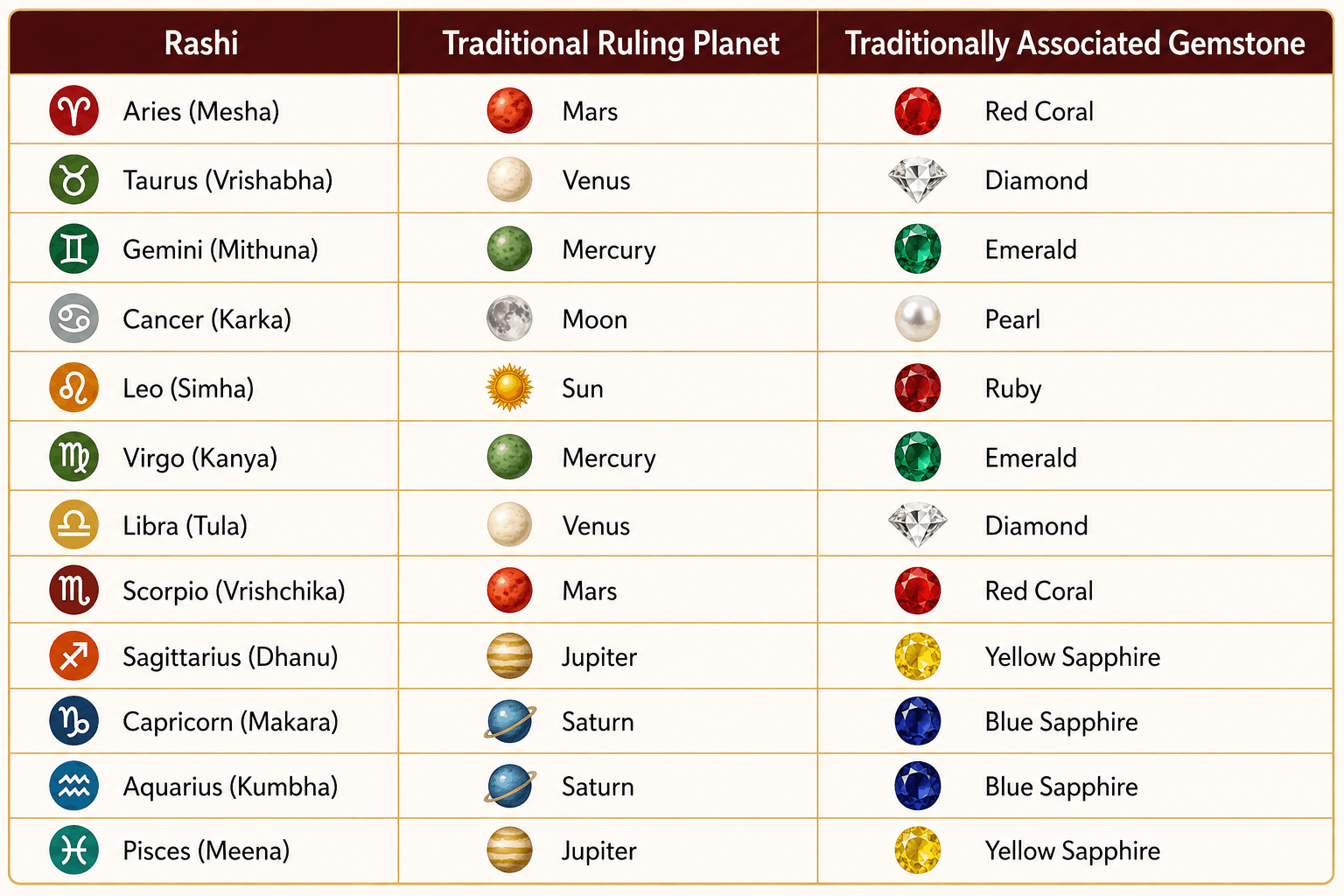
Important Note: The table is a general reference to traditional Rashi-gemstone associations. It should not be taken to mean that every Aries should wear Red Coral, every Leo should wear Ruby or every Capricorn should wear Blue Sapphire. A personal recommendation may be different after the complete Kundli is considered.
For a general Rashi Ratan reference, yes. For a personal horoscope-based recommendation, it may not be.
Your Rashi tells you where the Moon was placed when you were born. It does not tell you everything about your Lagna, houses or the positions of all the other planets.
This is why someone looking for a gemstone specifically according to their Kundli may be asked for their full birth details rather than just their Rashi.
They can.
Having the same Rashi means the two people share a Moon sign. It does not mean their entire birth charts are identical.
One person may have a different Lagna from the other. Their planets can occupy different houses, and their Dashas and planetary relationships may differ too.
So a Rashi chart may point both people towards the same traditional gemstone, while an individual horoscope reading may lead to different recommendations.
A birthstone and a Rashi Ratan aren't quite the same thing.
Birthstones are commonly linked with months of the year. You may have seen lists that assign one stone to January, another to February and so on.
Rashi Ratan comes from a different tradition. Here, gemstones are associated with Rashis and their ruling planets.
This distinction is useful when searching online because websites sometimes use terms such as birthstone, zodiac stone and Rashi gemstone rather loosely.
Before following a chart, check which system it is actually based on.
Knowing your Western zodiac sign does not necessarily tell you your Janma Rashi. If you are following a Vedic astrology approach, first make sure you know which sign the recommendation is actually referring to.
Your friend wears an Emerald. A relative was advised to wear Yellow Sapphire. That doesn't automatically make either stone suitable for you.
Their birth charts may be very different from yours.
Once people become focused on finding the "right" Rashi Ratan, they sometimes forget to check the gemstone itself.
Ask what you're buying. Is it natural? Has it been treated? What does it weigh? Is a laboratory report available for a valuable stone?
Those questions matter when money is changing hands.
Be careful when a gemstone is sold with guaranteed claims about wealth, marriage, health or career success.
Traditional astrology has its own beliefs about gemstones and planets, but that isn't the same as guaranteeing a particular event or outcome after someone wears a stone.
If all you need is a quick reference, a Rashi gemstone chart does the job well. It shows the traditional link between a Rashi, its ruling planet and a gemstone.
The question becomes more personal when you ask, "Which gemstone should I wear according to my horoscope?"
At that point, traditional Vedic astrology may bring the Janma Rashi, Lagna, planetary positions, houses and other parts of the Kundli into the discussion.
And once you know which gemstone you're considering, look at the stone itself. Check what it is, whether treatment has been disclosed, its weight and quality, and the available laboratory documentation for a valuable purchase.
In short, use the Rashi chart to understand the traditional association. Do not treat it as a rule that applies identically to everyone.
There isn't one stone that suits every horoscope. Your Rashi may point you towards a traditionally associated gemstone, but that is only a starting point. In Vedic astrology, the Lagna, planetary positions and the rest of the Kundli may also be looked at before a particular stone is suggested.
You'll need your date of birth, birth time and birthplace. These details are used to work out where the Moon was when you were born. The Rashi in which the Moon was placed is your Janma Rashi.
Start with your Janma Rashi if you want a general idea. If you're looking for something more personal, the answer may change after other parts of your Kundli are considered. This is why two people with the same Rashi aren't always given the same gemstone suggestion.
You can certainly use a Rashi or zodiac chart as a reference, but don't treat it as a personal prescription. A birth chart contains much more than one zodiac sign, particularly when the gemstone is being chosen for astrological reasons.
That depends on what is present in the individual Kundli. An astrologer following traditional Vedic astrology may look at the Lagna, houses and planetary placements before arriving at a recommendation. So there isn't a single gemstone that can be labelled the best for every Kundli.
Not quite. A birthstone is usually connected with the month in which a person was born. Rashi Ratans, on the other hand, are traditionally associated with Rashis and their ruling planets. The two systems can therefore point to different stones.
Yes. Sharing a Rashi only means that their Moon sign is the same. Their birth times, Lagna, planetary positions, houses and other parts of the Kundli can still be different. Because of that, a personalized recommendation may differ too.
For a valuable gemstone, it's worth checking the available laboratory report rather than relying only on the word "certified." See who issued the report and what it actually says about the stone. Remember, though, that a laboratory report describes the gemstone; it doesn't decide whether the stone suits your horoscope.
We Satisfied more than 700 Customers
Rahul Goyal leads Rahul Goyal Official, a Jaipur-based astrology and gemstone co...
Jaipur has its own reputation for gemstone cutting, polishing, trading and jewel...
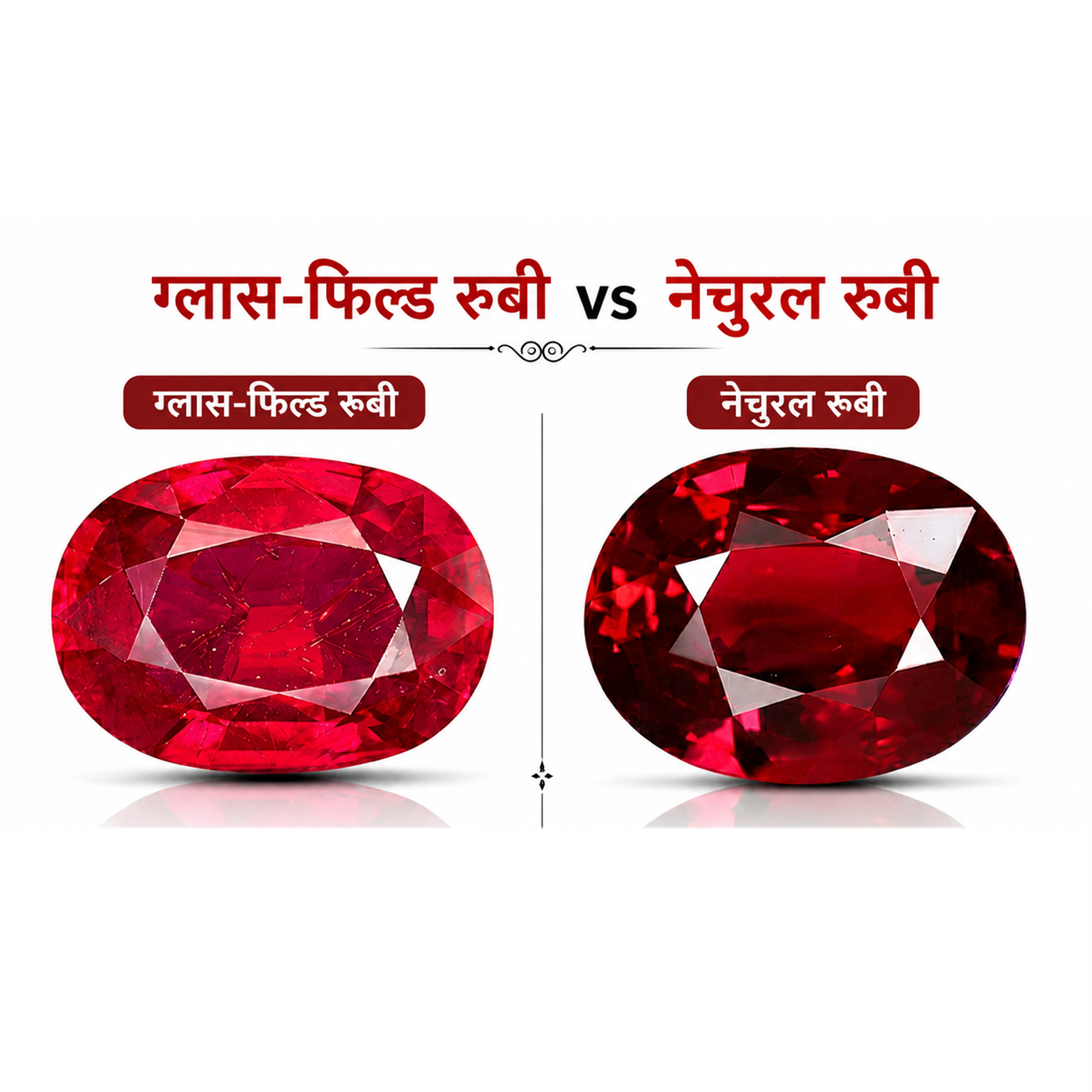
Natural Ruby vs Glass-Filled Ruby: पहचान कैसे करें और कौन-सा रूबी खरीदना चाहिए?...
The process of selecting the perfect gemstone involves more than just choosing a...
Buying a gemstone in Jaipur can be confusing, especially when similar looking st...
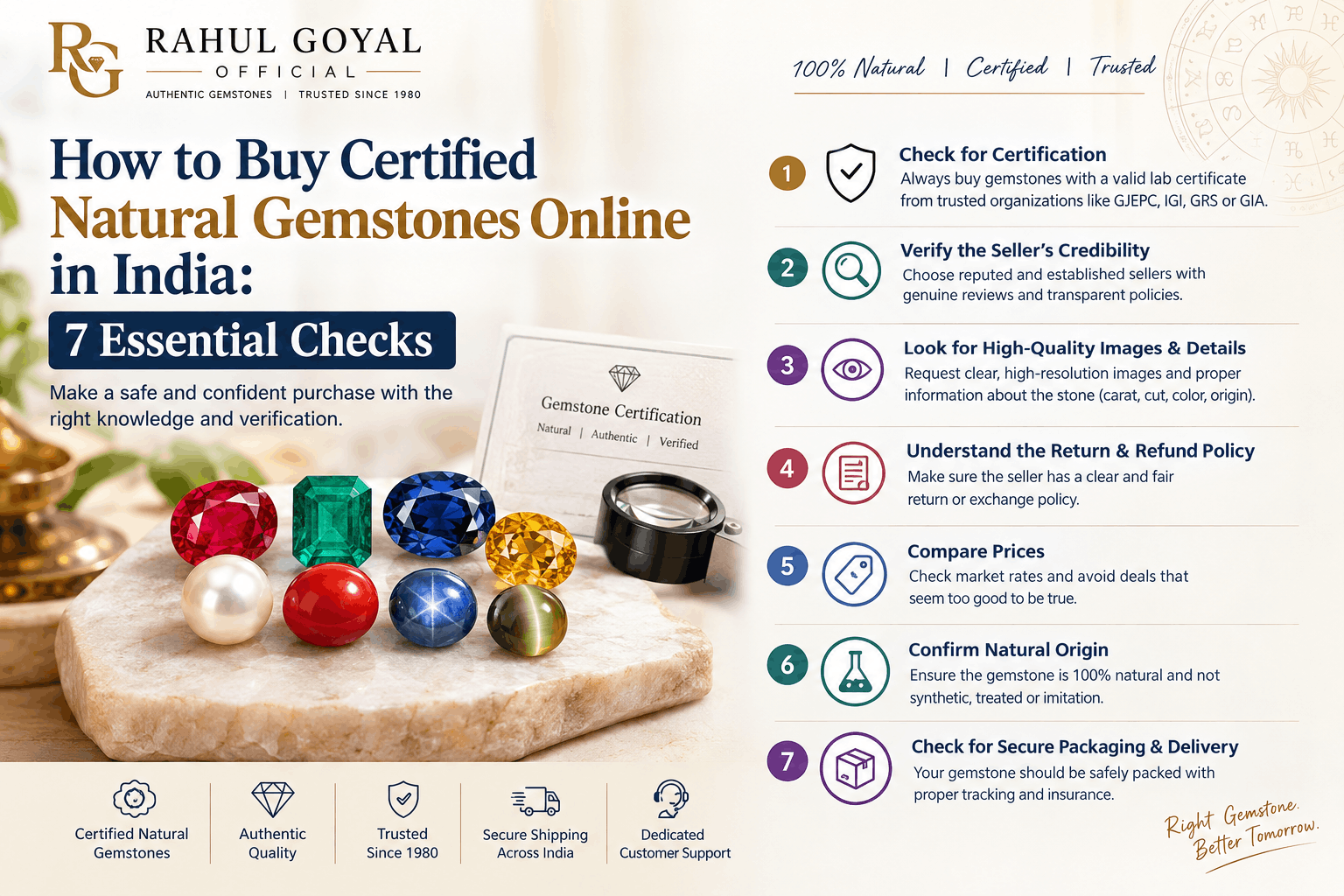
Quick Answer Buying a Certified Natural Gemstone online in India requires mor...
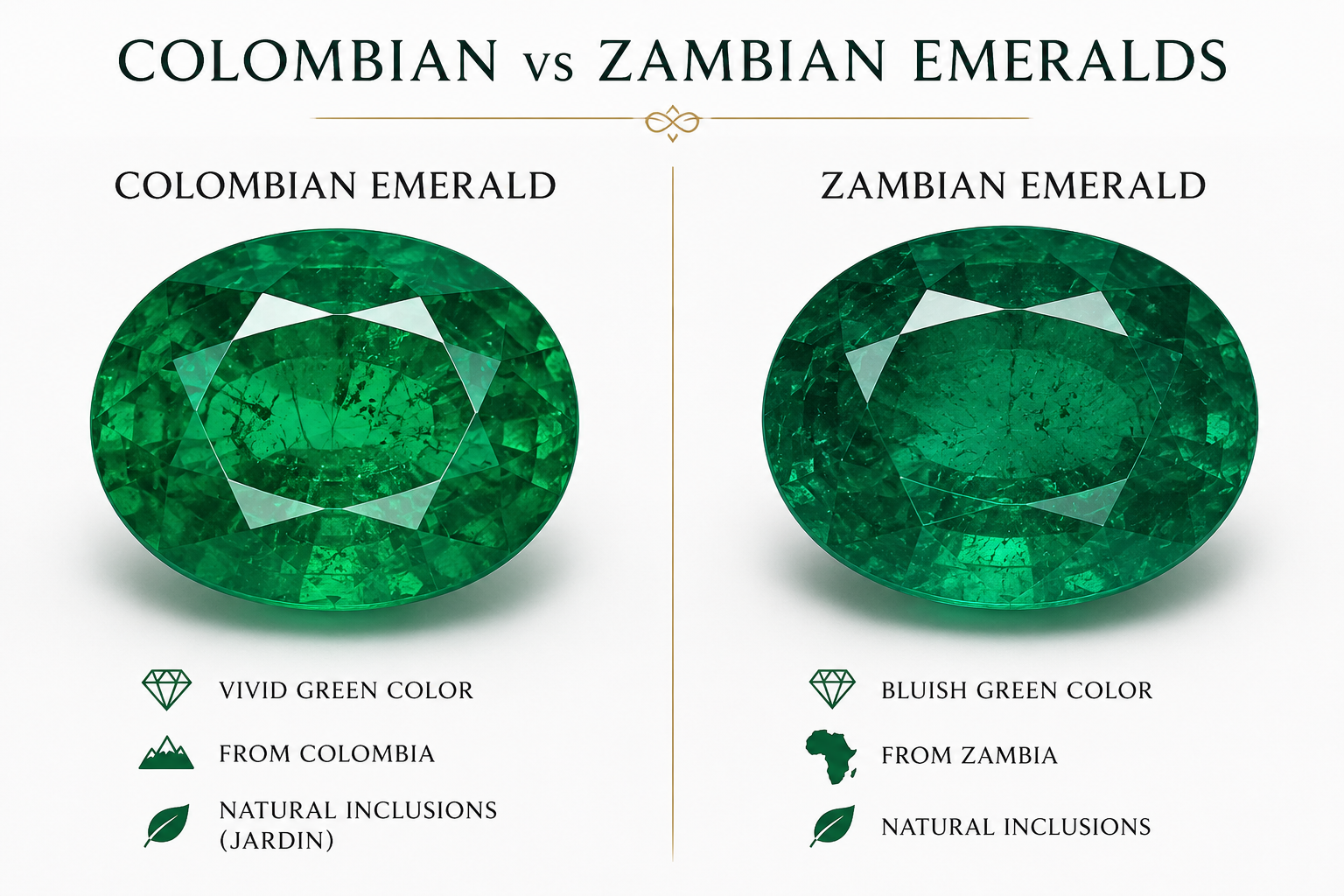
Two names dominate any conversation about where the best emerald comes from, Col...
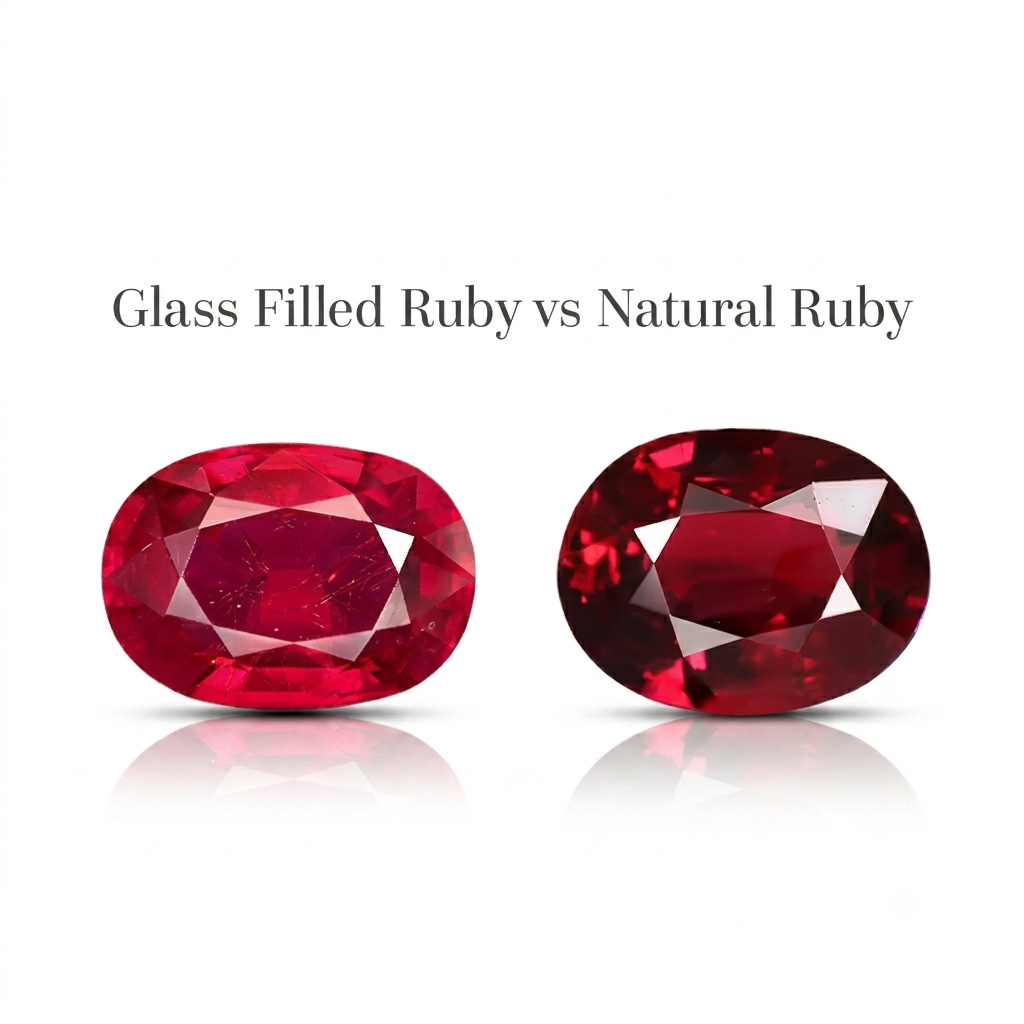
Ruby's one of the most sought after gemstones out there and in Vedic astrolo...
Discover our handcrafted silver treasures and add something beautiful.
Explore Collections