Gift Ideas for Diwali 2026 – Gemstones & Spiritual Gifts Best for Wealth and Prosperity
Diwali is a festival of happiness, prosperity, light, and new beginnings. It is...

By Rahul Goyal | 16th November 2026
Gemstones have an important place in Vedic astrology, where different natural stones are traditionally associated with planetary influences. From Ruby (Manik) and Emerald (Panna) to Yellow Sapphire (Pukhraj) and Blue Sapphire (Neelam), each gemstone carries its own astrological significance.
Many people explore powerful gemstone combinations in astrology to understand which stones can traditionally be worn together for wealth, financial stability, protection, confidence, and personal growth. However, selecting the right combination involves more than simply choosing two gemstones associated with friendly planets.
In Vedic astrology, planetary relationships, ascendant, house placements and the complete Kundli are considered when evaluating gemstone suitability.
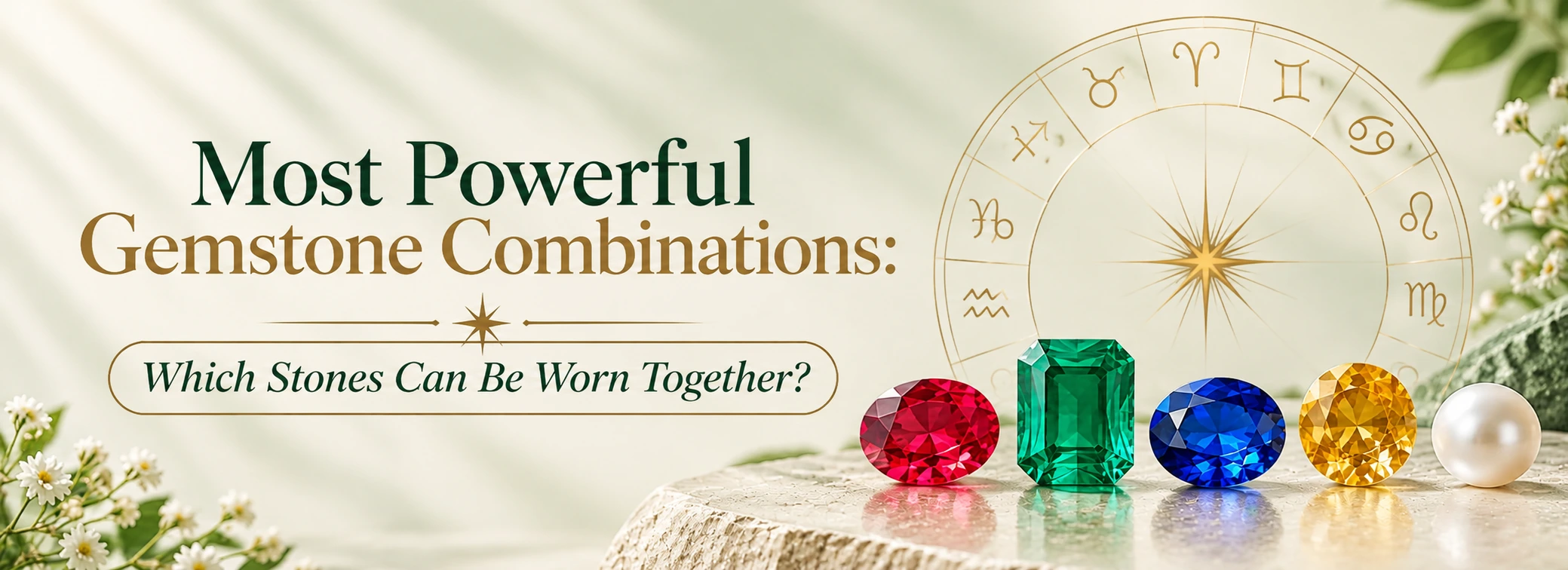
Quick Answer: Some of the most powerful gemstone combinations traditionally discussed in Vedic astrology include Ruby and Red Coral, Emerald and Diamond, Yellow Sapphire and Pearl, Blue Sapphire and Emerald, and Ruby and Yellow Sapphire. For wealth-related astrological recommendations, Yellow Sapphire, Emerald, Ruby, and Hessonite are among the gemstones frequently discussed. However, there is no universally best gemstone combination or single most powerful stone for everyone. The appropriate gemstone combination depends on an individual's birth chart, planetary positions, ascendant, and astrological tradition.
In Vedic astrology, each of the nine planetary influences, known as Navagraha, is associated with a particular gemstone. These are commonly known as Rashi Ratan or planetary gemstones.
For example, Ruby represents the Sun, Pearl represents the Moon, Red Coral represents Mars, and Emerald represents Mercury. Yellow Sapphire is associated with Jupiter, Diamond and Opal with Venus, Blue Sapphire with Saturn, Hessonite with Rahu and Cat's Eye with Ketu.
Gemstone compatibility in astrology is generally evaluated through three important considerations:
Understanding these factors helps explain why two gemstones may be considered compatible in general but may not necessarily be suitable for every individual.
Some gemstone combinations are traditionally considered compatible because their associated planets share friendly relationships. Here are five commonly discussed combinations.
Ruby (Manik) represents the Sun, while Red Coral (Moonga) represents Mars. Both planets are generally considered friendly in Vedic astrology.
This combination is traditionally associated with leadership, courage, confidence, and determination. It is often discussed in connection with people interested in developing leadership qualities and personal confidence.
Emerald (Panna) is associated with Mercury, while Diamond represents Venus. Mercury and Venus are traditionally considered friendly planets.
This combination is associated with communication, intelligence, creativity, and material comforts. Some astrologers consider it when evaluating charts related to business, communication, and creative pursuits.
Yellow Sapphire (Pukhraj) represents Jupiter, while Pearl (Moti) represents the Moon. Both planets are generally considered friendly in traditional Vedic astrology.
Jupiter is associated with wisdom, knowledge, and expansion, while the Moon represents emotions and the mind. Their combination is traditionally discussed in connection with wisdom, emotional balance, and personal development.
Blue Sapphire (Neelam) represents Saturn, while Emerald (Panna) represents Mercury. These planets are traditionally considered friendly in many Vedic astrology systems.
The combination is associated with discipline, analytical thinking, planning, and communication. However, Blue Sapphire recommendations can vary, and individual suitability should be evaluated through Kundli analysis.
Ruby (Manik) represents the Sun, while Yellow Sapphire (Pukhraj) represents Jupiter. Both planets are traditionally considered friendly.
This combination is associated with leadership, wisdom, confidence, and personal development. Its suitability depends on the individual's planetary placements and the astrological approach being followed.
There is no single best gemstone combination that applies to everyone. In traditional Vedic astrology, the most suitable combination is the one considered appropriate for an individual's ascendant, planetary placements, and house rulerships.
For example, Ruby and Yellow Sapphire are associated with friendly planetary relationships, while Emerald and Blue Sapphire are also commonly discussed as a compatible combination.
However, planetary friendship alone does not establish whether both gemstones should be worn together. A complete Kundli-based gemstone selection process is important before choosing multiple Natural Precious Gemstones.
In Vedic astrology, several gemstones are traditionally associated with prosperity, financial opportunities, business growth, and material development.
Yellow Sapphire (Pukhraj)
Yellow Sapphire (Pukhraj) is associated with Jupiter, which traditionally represents wisdom, knowledge, expansion, and prosperity. It is frequently discussed in astrological recommendations related to financial growth, education, and opportunities.
Emerald (Panna)
Emerald (Panna) represents Mercury and is traditionally associated with intelligence, communication, business skills, and analytical thinking. It is often discussed in connection with trade, entrepreneurship, and commercial activities.
Ruby (Manik)
Ruby (Manik) represents the Sun and is associated with authority, leadership, confidence, and recognition. In traditional astrological interpretations, it is considered when evaluating leadership and professional development.
Hessonite (Gomed)
Hessonite (Gomed) represents Rahu and is traditionally associated with ambition, unconventional opportunities, and material pursuits. Its recommendation requires careful consideration of Rahu's position in the birth chart.
The most powerful gemstone for wealth depends on the individual's Kundli. Wearing a gemstone does not guarantee financial success, business profits, or increased income.
People searching for the most powerful stone to attract money commonly explore Yellow Sapphire, Emerald, and Hessonite because of their traditional associations with Jupiter, Mercury, and Rahu.
Yellow Sapphire is associated with Jupiter's symbolism of prosperity and expansion. Emerald is connected with Mercury's symbolism of business, intelligence, and communication. Hessonite is associated with Rahu and is discussed in certain astrological traditions in relation to ambition and material pursuits.
However, there is no scientifically established gemstone that attracts money or guarantees wealth. Astrological gemstone selection should be based on individual chart analysis rather than choosing a stone solely for its popular reputation.
In traditional Vedic astrology, certain gemstones are discussed in relation to planetary protection, stability, and managing challenging planetary influences.
Blue Sapphire (Neelam)
Blue Sapphire (Neelam) represents Saturn and is traditionally associated with discipline, responsibility, and stability. Its recommendation depends on Saturn's role and placement in the birth chart.
Cat's Eye (Lehsunia)
Cat's Eye (Lehsunia) represents Ketu and is traditionally associated with spiritual awareness, detachment, and protection in certain astrological traditions.
Hessonite (Gomed)
Hessonite (Gomed) represents Rahu and is sometimes discussed in connection with managing challenging Rahu influences according to specific astrological interpretations.
These gemstones should not be treated as universal protective stones. Their suitability varies according to the complete Kundli and the tradition followed by the astrologer.
The most powerful stone is not necessarily the rarest, most expensive, or most popular gemstone. In Vedic astrology, the significance of a gemstone is traditionally evaluated according to its associated planet and the role that planet plays in an individual's birth chart.
For example, Ruby is associated with the Sun, Emerald with Mercury, Yellow Sapphire with Jupiter, and Blue Sapphire with Saturn.
A gemstone considered suitable for one person's Kundli may not be recommended for another person. Therefore, individual planetary analysis is more important than choosing a gemstone based on general popularity.
Some gemstone combinations in astrology are traditionally approached with caution because their associated planets are considered enemies in certain Vedic astrology systems. These classifications are not universal prohibitions.
The Sun and Saturn are traditionally considered enemies. Some astrologers advise caution when combining Ruby and Blue Sapphire because of their contrasting planetary associations.
Ruby represents the Sun, while Diamond represents Venus. These planets are traditionally considered enemies in many Vedic astrology systems. Individual chart analysis is important before combining them.
Pearl represents the Moon, while Blue Sapphire represents Saturn. These planets are often considered incompatible in traditional astrological interpretations.
Pearl represents the Moon, Hessonite represents Rahu, and Cat's Eye represents Ketu. Some traditional astrologers recommend caution with these combinations.
Red Coral represents Mars, while Emerald represents Mercury. Mars and Mercury are traditionally considered enemies in Vedic astrology.
Yellow Sapphire represents Jupiter, while Diamond represents Venus. These planets are traditionally described as enemies in many Vedic astrology systems.
These combinations are not universally forbidden. Their suitability depends on the individual's birth chart and the astrological tradition being followed.
These classifications reflect commonly discussed planetary relationships. They do not establish universal gemstone recommendations.
|
|
|
|
|
|
|
|
|
|
|
|
|
|
|
|
|
|
|
|
|
|
|
|
|
|
|
|
|
|
|
|
|
|
|
|
|
|
|
|
Yes, some people wear multiple gemstones according to traditional astrological recommendations. However, wearing more gemstones does not automatically make a combination more powerful or suitable.
Before selecting multiple gemstones, consider the purpose of each stone, planetary relationships, ascendant, house rulerships, and planetary placements in the Kundli.
It is also important to verify the gemstone's identity, natural or treated status, and available certification when purchasing Certified Natural Gemstones.
A Kundli provides the birth chart used in Vedic astrology. Astrologers may examine the ascendant, planetary positions, house rulerships, and other chart factors before recommending Rashi Ratan.
For example, Ruby and Red Coral are associated with friendly planets, but this does not automatically make them suitable for everyone. Similarly, Blue Sapphire and Emerald may be considered compatible through general planetary relationships without being appropriate for every birth chart.
A personalised Gemstone Consultation can help explain the astrological reasoning behind gemstone recommendations and whether a single gemstone or combination is considered appropriate.
Understanding powerful gemstone combinations in astrology requires more than knowing which gemstones represent friendly or enemy planets. Ruby, Emerald, Yellow Sapphire, Blue Sapphire, Red Coral, Hessonite and Cat's Eye each have distinct traditional associations in Vedic astrology.
Whether someone is exploring the best gemstone combination, the most powerful gemstone for wealth, the most powerful gemstone for protection, or the most powerful stone to attract money, individual Kundli analysis remains an important part of traditional gemstone selection.
Understanding planetary relationships, gemstone compatibility, and authenticity can help people make more informed decisions when exploring Natural Precious Gemstones, Natural Semi Precious Gemstones, and Rashi Ratan.
Ans: Ruby and Red Coral, Emerald and Diamond, Yellow Sapphire and Pearl, and Blue Sapphire and Emerald are examples commonly considered compatible in traditional Vedic astrology. The best gemstone combination depends on individual Kundli analysis.
Ans: Yellow Sapphire, Emerald, Ruby, and Hessonite are among the gemstones traditionally discussed in relation to prosperity, business, leadership and material pursuits. Their suitability depends on planetary placements.
Ans: Yellow Sapphire and Emerald are commonly discussed in Vedic astrology in relation to prosperity and business-related qualities. No gemstone is scientifically proven to attract money or guarantee financial success.
Ans: Blue Sapphire and Cat's Eye are discussed in certain Vedic astrology traditions in relation to stability and protection. Their suitability should be assessed individually.
Ans: Their associated planets, Jupiter and Mercury, are not universally considered friendly in traditional Vedic astrology. This combination requires individual assessment rather than a general recommendation.
Ans: Emerald and Blue Sapphire are often considered compatible because Mercury and Saturn are traditionally described as friendly planets. Individual suitability still depends on the birth chart.
Ans: Ruby and Blue Sapphire, Pearl and Blue Sapphire, Red Coral and Emerald, and Yellow Sapphire and Diamond are commonly discussed as combinations requiring caution.
Ans: No. In Vedic astrology, gemstone suitability is traditionally assessed through planetary associations and Kundli placements rather than price alone.
Ans: An astrologer may examine your birth date, birth time, birthplace, ascendant, planetary positions and house rulerships before recommending a gemstone.
Ans: No. Astrological gemstone recommendations are based on traditional belief systems. Their attributed effects on wealth, protection, health or personal success have not been scientifically established.

Need guidance or a personal consultation? Share your query with our team and we will get back to you with the right advice and support.
Contact Us
Diwali is a festival of happiness, prosperity, light, and new beginnings. It is...

Karwa Chauth is more than just a traditional festival. It is a beautiful occasio...
Choosing a gemstone is not just about its colour, beauty, or price. In Vedic ast...
Quick Answer The top 10 precious and semi-precious gemstones covered in this...
Discover our handcrafted silver treasures and add something beautiful.
Explore Collections